Vatican II
We can now look at how Father Philippe viewed the contribution of the Second Vatican Council to the life of the Church.
Firstly, highlighting the way in which the Council asked the Church to open up to the world, Father Philippe has always interpreted it as an invitation to Christians to become philosophers, so as to be able to dialogue with those who do not share the Christian faith. This was one of the remarks later made by Pope John Paul II: “Philosophical thought is often the only ground for agreement and dialogue with those who do not share our faith[1]“.
On the other hand, as early as the 1970s, Father Marie-Dominique Philippe explained the meaning of the Council as analogous to the role of John the Baptist in the divine economy:
John the Baptist (…) is the one who must “close a house”, since he is at the end of the whole Old Testament waiting. Obviously, it’s easier to open a house than to close one. John the Baptist, on the other hand, had to close a house, and a house that was two thousand years old! From Abraham to John the Baptist… that’s no mean feat! And this little John the Baptist will have to say to the high priests of Jerusalem: “It’s finished, accept that another one goes before.” It’s not easy! Isn’t that the “drama” of Vatican II? We have to accept that an entire great tradition is being taken back to its source, in poverty. The “Church of the poor”, that’s what we’re living. We’re living through something that John the Baptist experienced with great intensity, and we have to live within the blossoming of a springtime – that’s what’s so extraordinary! The Church must both be the Church of the poor and live this mystery of spring. It may seem contradictory, but it’s true. Isn’t this a great demand of the Holy Spirit? Especially if the Church is to live out the last stage before Christ’s return (if we have reached the end of the great wait for Christ’s return), in fraternal charity? For the Church is made to await the return of Christ; whereas the Old Testament awaited the coming of the Messiah in adoration, the Church awaits the return of Christ in fraternal charity. Adoration is still fundamental, of course, but it leads to fraternal charity. And it’s fraternal charity that the Holy Spirit wants us to live out, making us understand that adoration is transformed, within us, into charity. There is no opposition between the two: adoration is a source of charity. It’s very important to take a good look at John the Baptist, because he makes us understand what we need to live. Once again, isn’t the Church going through a final stage? I didn’t say it would be tomorrow, but it’s undoubtedly a final stage that the Church is currently living through – and it’s also the most beautiful stage! We are privileged by God to be living this last stage, for it is the most beautiful of all the Church’s life. The Church must both be impoverished, living out the mystery of John the Baptist (since John the Baptist is to return at the end of time, clothed in the spirit of Elijah, to announce the return of Christ), and at the same time experience the blossoming of a springtime. She must live these two mysteries simultaneously, the blossoming of a springtime in poverty – the poverty of accepting that the Church’s pilgrimage is coming to an end, and that the Church is not eternal, at least not on earth, for it is eternal in Heaven; but the Church on earth, the Church militant, is not eternal. “The gates of hell shall not prevail against it”, that is to say, the Church will remain to the end of the world, but she will have to accept that her pilgrimage is coming to an end. That’s why she must be poor and clothed in the spirit of Elijah, the spirit of John the Baptist.[2]
“It’s very important to take a good look at John the Baptist, because he makes us understand what we need to live. Once again, isn’t the Church going through a final stage? I didn’t say it would be tomorrow, but it’s undoubtedly a final stage that the Church is currently living through – and it’s also the most beautiful stage! We are privileged by God to be living this last stage, for it is the most beautiful of all the Church’s life. The Church must both be impoverished, living out the mystery of John the Baptist (since John the Baptist is to return at the end of time, clothed in the spirit of Elijah, to announce the return of Christ), and at the same time experience the blossoming of a springtime.”
This is the light that Saint John Paul II himself gave to the whole Church at the Jubilee Year 2000, interpreting the Second Vatican Council as the spirit of the Prophet John the Baptist, pointing out Christ, the Lamb of God, to the contemporary world:
From this point of view we can affirm that the Second Vatican Council was a providential event, whereby the Church began the more immediate preparation for the Jubilee of the Second Millennium. It was a Council similar to earlier ones, yet very different; it was a Council focused on the mystery of Christ and his Church and at the same time open to the world. This openness was an evangelical response to recent changes in the world, including the profoundly disturbing experiences of the Twentieth Century, a century scarred by the First and Second World Wars, by the experience of concentration camps and by horrendous massacres. All these events demonstrate most vividly that the world needs purification; it needs to be converted.(…) The Council, while not imitating the sternness of John the Baptist who called for repentance and conversion on the banks of the Jordan (cf. Lk 3:1-7), did show something of the Prophet of old, pointing out with fresh vigour to the men and women of today that Jesus Christ is the “Lamb of God who takes away the sin of the world” (Jn 1:29), the Redeemer of humanity and the Lord of history.[3]
Finally, Father Marie-Dominique Philippe has always insisted on the Council’s invitation to take up the whole of theology in the perspective of the divine economy, which he developed over many years, thus assuming with others (including Joseph Ratzinger) in the light of the truth of faith, the research that was first born in the Protestant world in opposition to the metaphysical dimension of theology and developed as “salvation history”. Divine economy means taking up again the dimension of God’s government from the perspective of wisdom, and not contenting ourselves with the descriptive exposition of a story, even a holy one.
[1] Encyclical letter Fides et Ratio, no. 104; and many other places.
[2] Following the Lamb, I, p. 164-166.
[3] Apostolic Letter Tertio millennio adveniente (1994), nos. 18-19.
Two Popes
This evocation of his view of the meaning of the Second Vatican Council in the life and progress of the Church, also invites us to recall the importance of his encounter with the two great Popes of the Council: the one who brought it to its conclusion, Saint Paul VI; and the one who was its first interpreter for the contemporary world, Saint John Paul II.
His only meeting with Saint Paul VI took place in September 1965, as the Council was drawing to a close, during an audience with the participants in the VIe International Thomistic Congress. In his address to them, the Pope pointed to “the misunderstanding of a certain number of believers who are today tempted by a revived fideism. Ascribing value only to scientific thought, and defying the certainties proper to philosophical wisdom, they are inclined to base their adherence to the order of metaphysical truths on an option of the will”.[1] In the face of this “abdication of intelligence”, Pope Paul VI felt it necessary to recall “the indispensable value of natural reason”. In fact, according to the entire Tradition of the Church, and as the First Vatican Council forcefully reminded us, the human intelligence is capable of attaining truth on its own, and of rising to the discovery of the existence of the One whom traditions call God. Of this confidence in human intelligence, “St Thomas Aquinas is one of the most authoritative and eminent witnesses”.[2] Father Philippe was so struck by Paul VI’s speech that he evoked it frequently right up to the end of his life,[3] often recalling how damaging the error of fideism is, and how it has immense consequences for faith and intelligence.
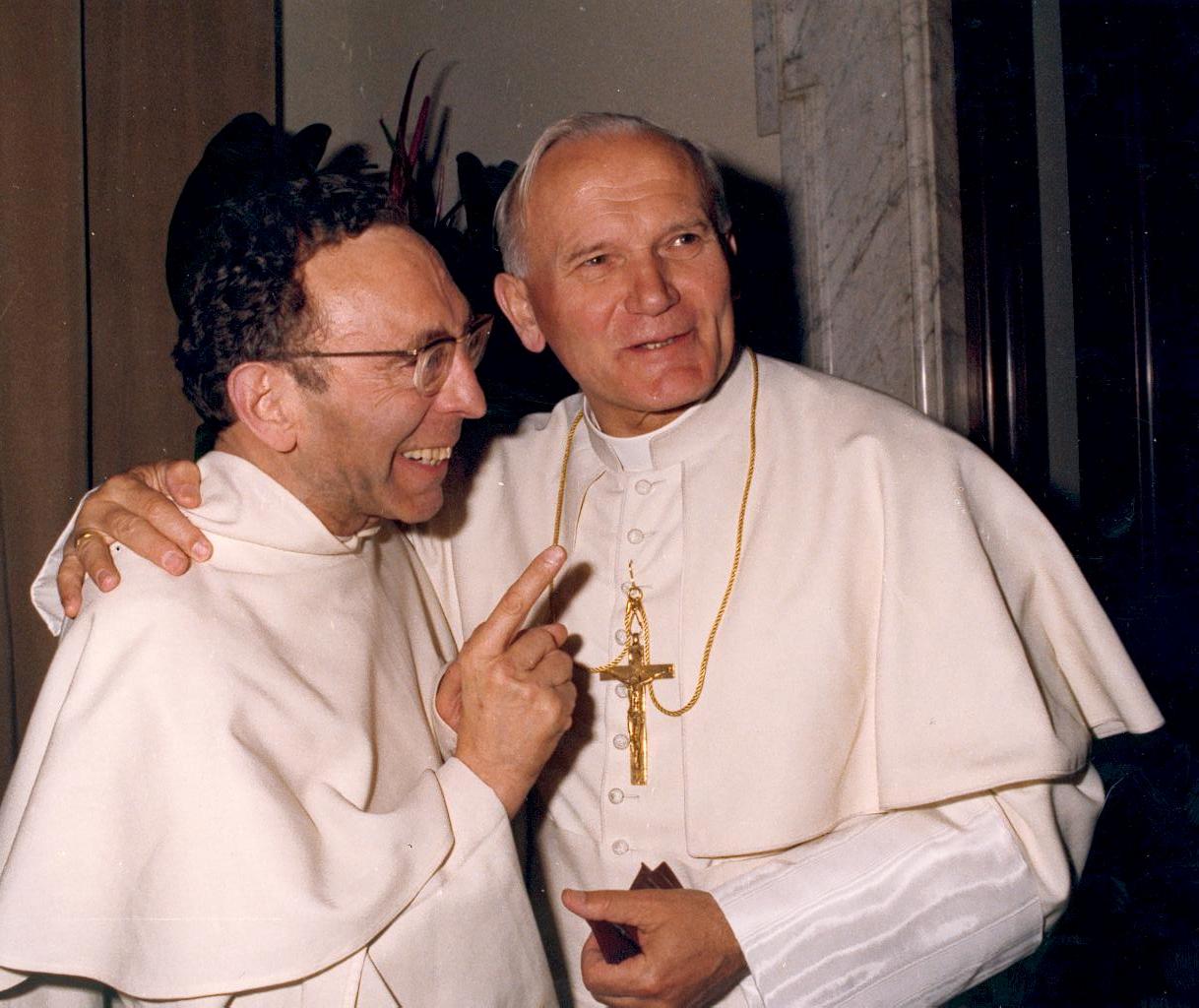
As for his meeting with the man who was to become Pope John Paul II, it took place, the first of many, in April 1974, before the founding of the Community of Saint John. Father Marie-Dominique Philippe has often recalled the circumstances:
- Your commitment to the new evangelization also illustrates, by ricochet, your personal complicity with John Paul II. Can you recall the circumstances? – It all began with a curious coincidence. It was in Italy, during a Thomist congress organized to mark the seventh centenary of the death of Saint Thomas Aquinas (1974). The congress was held in Rome, under the presidency of Paul VI, and in Naples, under the presidency of Cardinal Wojtyla. At the time, I was teaching philosophy in Fribourg. I didn’t really want to attend the congress; I was afraid of wasting my time! Then the Master General of the Order gave me a formal order to go and give a paper. So I obeyed. In Rome, I was quite bored. In Naples, I found myself staying in the same hotel as Cardinal Wojtyla. Every morning, we had breakfast together. He made a strong impression on me and struck me as a fearless apostle, a true apostle. We talked a lot together about philosophy, apostolic life and so on. It was fascinating. He was an ardent seeker of truth. – What happened next?
- Cardinal Wojtyla came to Fribourg, I believe the following year. I was able to meet him again and speak freely with him. Our conversation seemed to pick up where we left off. Cardinal Wojtyla went on to become Pope. What happens to a cardinal’s friendships when he ascends the throne of Peter? I saw him again in Rome about a year after his election, and then went back at his request. And we’ve always continued to talk philosophy… His intellectual training is quite different from mine, but what has brought us together, I repeat, is the search for truth and the concern not to lock oneself into a system.[4]
What constantly struck Father Marie-Dominique Philippe in his meetings with John Paul II was the Pope’s insistence on the importance of “metaphysics”, a reference to the passage from the encyclical Fides et Ratio that we quoted above.[5]
Every time I see him, the Holy Father asks me if metaphysics is going well! Once he even said to me: “Father Philippe, do you have any successors?” And two minutes later: “But, Father, where do they still teach metaphysics? the real thing?” That really impressed me: where do people still teach real metaphysics? This is one of the Pope’s great concerns, because he can see that all the theological errors of today stem from a lack of philosophy, from a concern for generosity that is too immediate, where we don’t go back far enough to the source. We rush into things, and when we rush into things, we leave behind the gaze of wisdom, we leave behind the gaze of divine truth.[6]
This providential meeting with John Paul II was for Father Marie-Dominique Philippe a confirmation of the importance of his work for the Church and for the contemporary world; it was also a precious support in accepting to enter into what the Lord would ask of him as a new service, and to carry it out in the midst of many struggles: to give birth to the Community of Saint John and to accept to be its Founder.
[1] S. PAUL VI, “Allocution du 10 septembre 1965 aux participants du VIe Congrès thomiste international”, French text published by L’Osservatore Romano, September 13-14, 1965; Documentation catholique no. 1457, October 17, 1965, col. 1747-1750).
[2] Ibid.
[3] Among many other texts, see for example: “Far from being merely a crisis of Christian culture, the crisis we are facing is a crisis of human intelligence in search of truth. Is this not the cry of alarm sounded by our Pope in his encyclical Fides et ratio, when he emphasized that contemporary man has somehow lost the hope of discovering the truth (Fides et Ratio, no. 5). How, in such conditions, can faith take root and develop in all its demands? Didn’t Pope Paul VI already point out that one of the greatest dangers facing the Catholic Church is fideism? Indeed, if the human intelligence is not capable of seeking the truth and discovering the existence of God, faith can no longer take root or develop. And so the Christian life, which is lived in faith as long as we are on this earth, disappears. Let’s remember Jesus’ cry in St. Luke’s Gospel: ‘Will the Son of Man, when he comes, find faith on earth?’ (Lk 18:8)” (“La vie monastique, une source de renouveau pour l’Europe contemporaine”, in: Aletheia, n°25, Rimont); “Q/ Is it important for a Christian to do philosophy? R/ It’s essential! Otherwise, they quickly fall into fideism, and their faith gradually diminishes. Paul VI forcefully asserted that the greatest danger for the Church was fideism, i.e. the assertion that faith alone gives us the truth. Fideism is a complete abdication of human intelligence” (“Mon plus grand désir: comment lui plaire?”,”My greatest desire: how can I please him?” interview with Famille chrétienne, August 30, 2002, published September 14, 2002).
[4] Interview with Samuel Pruvot, France catholique, May 2001.
[5] Cf. above, p. 75.
[6] Les trois sagesses, p. 263: “My first contacts with John Paul II, before he was elected pope, were at the philosophical level, and the dialogue we had was at this philosophical level, of a search for truth in today’s world. Once (when he was already Pope), I asked him: “Most Holy Father, I would like to enter fully into your philosophy, for you are indeed concerned with a knowledge of man, and therefore with an anthropology, but an anthropology that opens onto a metaphysics, because we cannot fully study man if we do not discover in him the concern, the desire to discover the existence of God.” There was then a silence; then the Pope, with great simplicity and marvellous humility, said to me: “Thank you, Father, for saying that to me…” I found that very beautiful. I had a filial concern to enter fully into his point of view, to be in conformity with him, and then to understand him well. And he emphasized that this was his concern. And it’s true (as many people feel): today’s most profound errors stem from a lack of philosophy. Some bishops have told me: all the errors of today come from philosophy” (ibid., p. 264).


Leave a Reply