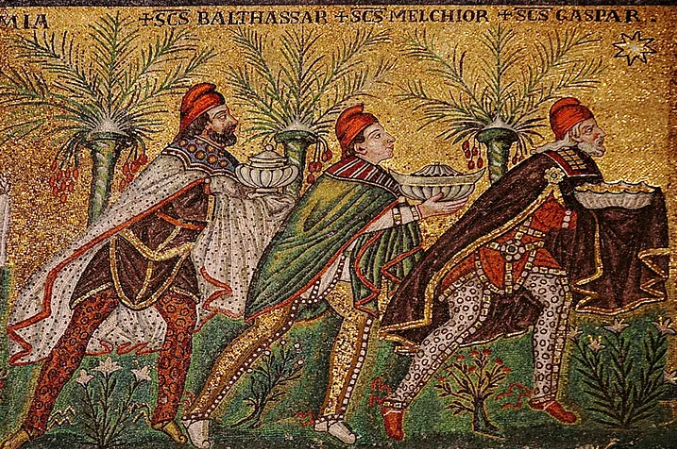
Gold, Frankincense, Myrrh: Silent prayer is making acts of Faith, Hope and Love
Silent prayer is Christ’s invitation to enter into communion with him, into intimacy with him. We offer him what we hold most precious: gold, frankincense, myrrh. We offer him what is in the innermost depth of our hearts and what is most precious: gold, which symbolizes love. We tell Jesus of our love, our desire to love, our thirst for love, and our inability to love. This is part of prayer.
Offering frankincense symbolizes adoration. We adore Jesus in the Blessed Sacrament, and we adore him by discovering him in the innermost depth of our hearts. We adore him knowing that he sees us, that he loves us, that he is present in the deepest secret of our hearts.
Offering myrrh is offering Jesus all our sufferings. The Magi did not hesitate to spend a great deal of time on this encounter. For us, it is much simpler: we can have a place at home reserved for prayer, a “prayer corner,” and every day we can have a silent, intimate liturgy there: kneeling before the present Jesus who sees us.
Silent prayer is therefore this mystery of the nuptials of our soul with Jesus, the transformation of our heart in the heart of Christ. Our heart, in fact, is capable of loving, but our love is only water; it does not have the intensity, the strength, and the penetration of divine love, which is symbolized by wine. Jesus wants to teach us to love. Silent prayer is the school of love, and it is Jesus himself who wants to teach us to love. Now, we know that to love is the most important thing in our whole life. We should therefore come every day to Jesus for five minutes, ten minutes, a quarter of an hour, to pray, to do silent prayer.
How does this transformation of our heart into the heart of Christ take place? It takes place when we exercise our faith, our hope, and our charity. Silent prayer is the most divine exercise of our theological virtues. It therefore implies the will to exercise our virtues of faith, hope, and charity (agape) with acts, in the presence of Jesus, desiring to be in this face-to-face encounter. This face-to-face encounter remains obscure, shrouded in darkness, since we do not yet see the face of Jesus; but we know that he sees us. Now, when we know that someone is looking at us and penetrating to the very depths of our being, we too can very well remain fixed on his gaze. Jesus looks at me; he is present there; there is no distance between him and me. He is in the deepest part of my heart, he is in the deepest part of my mind, of my intellect, beyond all words, all reasoning, all meditation. He is present there like a source of light and love, like a person who gives himself to me.
This face-to-face encounter remains obscure, shrouded in darkness, since we do not yet see the face of Jesus; but we know that he sees us. Jesus looks at me; he is present there; there is no distance between him and me.
Oraison is becoming divinely aware—I insist: divinely, not psychologically—of this presence of Jesus. He is present to me in faith, hope, and love; he is more present to me than I am to him. Here we discover the need to go beyond the psychological point of view. If we remain in our psychological awareness, we remain at the level of meditation. If we transcend it by adhering to Jesus’ gaze upon us—this gaze transcends us, it goes infinitely further—we enter into this intimacy with him, we enter into silent prayer. There, there are no more limits since Jesus, in fact, carries us—he is the Word of God.[1] Jesus takes hold of us and seizes us. Jesus draws us: “When I am lifted up from the earth, I will draw all people to myself.”[2] In our act of faith, words from the Gospel return; words we love, always the same, yet always new, since every day we progress in faith, and thus enter into a greater intimacy with Jesus.
It is precisely this intimacy with the heart of Jesus, this intimacy with the person of Christ, that we seek in mental prayer; this is what we thirst for. And we renew our acts of faith in Jesus’ gaze upon us, in his word. Silent prayer is a silent prayer of faith. This also explains why, on some days, our mental prayer leaves us in a state of dryness. We see nothing at all. Psychologically we are dry, drier than during the rest of the day, like dry, arid land.[3] The psalmist says that he is like a weary beast of burden, who can’t go on, ut jumentum:[4] that is very beautiful. Or we are like a faithful dog who stays there, who doesn’t understand anything at all, but who knows that he must be there. After all, since we know that we must be there, we will be there—we are giving our time for God. Today, time, especially for busy people, is gold. It’s our gold. So we spend that time for God. When we spend our time for God, when things are hard, when we’re constantly checking our watches, we ask Jesus to help us. In an instant, he can make what is dark and barren become bright and burning with love. But perhaps Jesus is testing us this way? He is testing us to see if we are faithful.
When we say we have had a “good” oraison, it means that time passed very quickly for us, and that we felt a kind of warmth or light inside—it was wonderful: Jesus was there! And if we have a little imagination, we might even believe we were having visions or hearing words. But oraison is beyond imagination. Oraison is faith, and faith in its purest form; faith that is all-loving, certainly, but all-poor. It is the hope of the poor who rely on the heart of Jesus. It is burning charity, in faith. Silent prayer is making acts of the three theological virtues in the most divine way possible. We begin by wanting to exercise our faith, hope, and charity. And little by little, the Holy Spirit himself helps us, and makes us become, under his wing,[5] like little eagles. Mental prayer is letting ourselves be led by the Holy Spirit, and believing that the Holy Spirit allows us a truly divine exercise of faith, hope, and charity. At that moment, the presence of Jesus, the presence of Mary, the presence of the Father, becomes intimate. We think of nothing; we simply love. The Father is present, Jesus is present. I look at him, and he looks at me. There is no imagination involved; it is solely a gift of ourselves, and receiving the gift of Jesus, who gives himself entirely, to the very end.
Silent prayer is letting ourselves be led by the Holy Spirit, and believing that the Holy Spirit allows us a truly divine exercise of faith, hope, and charity. At that moment, the presence of Jesus, the presence of Mary, the presence of the Father, becomes intimate. We think of nothing; we simply love. The Father is present, Jesus is present. I look at him, and he looks at me.
The practice of the theological virtues allows us to say the “Our Father.” It is good to repeat in prayer the prayer of Jesus, according to the rhythm of his heart: “Our Father…” To place ourselves in the presence of the Father. It is the Holy Spirit who, in the depths of our being, makes us say: “Abba, Pater, Father.”[6] For Saint Thomas, saying “Father” in this way is the highest mystical experience. In faith, we are children of the Father, children of light. In hope, we are those who are carried by Christ, drawn by the Father. We can say in all truth: “Father,” and recite with Jesus the “Our Father.” And Jesus offers us to the Father.
[1] Cf. He 1:3 : “The Son (…) sustaining all things by his powerful word.”
[2] Jn 12:32.
[3] Cf. Ps 63:2; Is 44:3; 58:11; Rev 22:17.
[4] Ps 73:22 (Vulgate 72:23).
[5] Cf. Dt 32:10-12.
[6] Rm 8:15 ; Ga 4:6.
 Father Marie Dominique Philippe, O.P.
Leave a comment