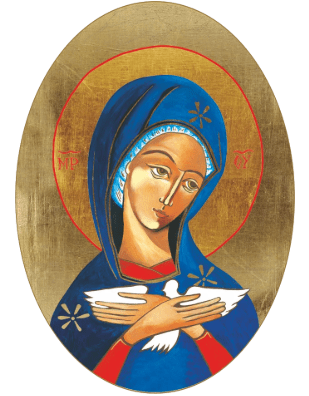
Commenting on the passage about the wedding feast at Cana, Saint Thomas Aquinas emphasizes that Mary is always invited.[1] At the wedding at Cana, she is present; and every time we enter our room, close our door, and wish to discover in the secret of our hearts the presence of the Father,[2] Mary is present. Let us understand, then, that, if we are well-mannered children, it would be good to look at her!
[1] Commentary of the Gospel of Saint John, no. 343.
[2] Cf. Matt 6.
There was a brief dialogue between Mary and Jesus at Cana. To look at Mary does not distract us from true mental prayer, to ask her to be there and to help us go further, to enter more deeply into this mystery of love. This is Mary’s role, Mary’s haste. When everything is dry, when it is like a desert, when we are truly ut jumentum, like a beast of burden, we must more than ever look to Mary and beg her to be present, to help us.
What is Mary’s role in mental prayer? Saint Thomas tells us that she is “counselor for the wedding feast.” Let us understand what this means. Each of us is unworthy of this wedding feast: we do not have the wedding garment. We are unworthy because we are sinners. And yet, the Holy Spirit wants us to enter into this intimacy with the heart of Christ. So Mary is given to us. The only one worthy of silent prayer is the Immaculate Conception, she who has the fullness of grace and love. And Mary is given to us to allow us to enter into this intimacy with Jesus, to allow us to be very close to him, to truly love him (without always struggling against our imagination, against temptations), to rest near the heart of Jesus and to love him. Mary is there to present our soul to Jesus, and to tell him to take possession of us, to transform water into wine. Mary is there to allow Christ’s action upon our soul, this profound action, to be fully accomplished under the guidance of the Holy Spirit. Mary is there to give us the Holy Spirit and to allow us to be entirely docile to his action: that he may truly take complete possession of us and that we may never resist him. Only Mary can make this possible, because, by nature, we do resist the Holy Spirit. By nature, we let ourselves be carried away by our imagination, which plays very bad tricks on us in the order of mental prayer. It makes us resist the Holy Spirit; it prevents him from acting freely. It is therefore very important to understand Mary’s role as, “counselor at the wedding”: the one who presents our soul to Jesus, the one who wants to go to the very end of this transformation of our heart into the heart of Jesus.
Mary is there to give us the Holy Spirit and to allow us to be entirely docile to his action: that he may truly take complete possession of us and that we may never resist him.
In closing, I would like to read you a text that you may already be aware of, and it seems to me entirely relevant, entirely appropriate. It’s taken from André Frossard’s Portrait of John Paul II. André Frossard has the audacity to ask, “Holy Father, how do you pray?”
The Holy Father could have said: “When you want to pray, enter the secret of your heart, close the door to all chatter, and there, in secret, pray to your Father.” But the Holy Father is so merciful and so paternal that he didn’t hesitate to answer this question, which André Frossard himself calls “indiscreet.” The Holy Father then replies: “I’m going to tell you an anecdote.” “When I was about ten or twelve years old, I was an altar boy, but I wasn’t very diligent, I must admit.” My mother was no longer there. It was my father who noticed my lack of discipline, and so said to me one day: “You are not a good altar boy. You don’t pray enough to the Holy Spirit. You must pray to Him.” And he showed me a prayer.”
He had the audacity to ask Pope John Paul II, “Holy Father, how do you pray?”
— “You haven’t forgotten it?” said André Frossard. — “I haven’t forgotten it. It was a major spiritual lesson, more lasting and stronger than all those I have since learned from my reading and the teachings I have received. With what conviction he spoke to me! I can still hear his voice today.”[1] How beautiful, this ten-year-old child listening to his father correcting him. Jesus teaches us the secret of prayer by giving a correction: “You must not pray like that.” And the father of our Pope said to a ten-year-old boy: “You shouldn’t be an altar boy like that.”
[1] A. Frossard, Portrait de Jean Paul II, éd. Robert Laffont 1988, p. 79.
The Holy Father continues: “With what conviction he spoke to me! I can still hear his voice today. The result of this lesson from my childhood is my encyclical on the Holy Spirit.” “It is unlikely,” comments André Frossard, “that the small, often accidental, religious dialogues we may have with our children will ever produce encyclicals. However, we never know how strongly words can make an impact. We think they are lost, and, like the mustard seed in the parable, one day they become great trees.” — “In my youth,” the Holy Father continues, “I prayed to obtain the gifts of the Holy Spirit that seemed to me the most relevant according to the circumstances.” Then I understood that the final message belonged to Saint Paul, who tells us in his Epistle to the Romans: “The Spirit helps us in our weakness, for we do not know what to pray for as we ought. But the Spirit himself intercedes for us with groanings too deep for words.” I see no other way to express my personal prayer than with these words of Saint Paul. Ultimately, it is always the Holy Spirit who interprets our prayer—which is bigger than we are. (…) God took the terrible risk of freedom. But he helps our freedom, which finds its fulfillment in love. Which involves all the gifts of the Holy Spirit, and first of all the ‘fear of the Lord,’ the beginning of all wisdom.” I believe that this is truly what prayer is: begging Mary to place us in this complete docility toward the Holy Spirit and his seven gifts, to let ourselves be carried away by the flight of the eagle, to let ourselves be carried away by the Holy Spirit. We must desire it. If we are carried away, we can let the Holy Spirit act. And if we are not carried away, we can ask to be so in order to love under the action of the Holy Spirit, to remain in the heart of Christ, in sinu Patris, in the bosom of the Father, where the beloved Son dwells.
~ AFC 1988 “Seigneur, apprends-nous à prier”
 Father Marie Dominique Philippe, O.P.
Leave a comment