Book of Revelation
“And the Dragon stood before the Woman who was about to give birth [here we see his cunning] to devour her child as soon as she had given birth to it.” The devil is sadistic: he wants to devour the child right before the Woman’s eyes. If he could do that, he would, to show the fragility of this physical world, of this earthly world, to show that it is unsustainable, that God made a terrible mistake in creating this universe. The devil is convinced that God was wrong, and he wants to prove it: God should not have done this. It is not worthy of God to create such a fragile universe, to create beings who do not keep their word, who no longer know their own dignity. “…To devour her child as soon as she gave birth to him. And she gave birth to a son, a male child who is to rule all nations with an iron scepter. And her child was caught up to God and to his throne.” Here we see the mystery of Mary’s divine motherhood in relation to Jesus and in relation to the Church. It is truly magnificent to see the Church in this light, and to see the mystery of Jesus in this light. In the face of Jesus, the devil can do nothing, yet he has pursued him.
The Book of Revelation shows us how the devil viewed Jesus: he saw him as the number one enemy who had to be eliminated. But he could do nothing to him, and this is shown to us here: “And she gave birth to a son, a male child, who is to rule all the nations with an iron scepter [this is the mission of Christ, the Messiah], and her child was caught up to God and to his throne.” The devil was completely ignorant of the mystery of Jesus. His curiosity led him to form all sorts of hypotheses; he suspected that he was someone very great, but he did not know him. He remained on the outside, because his gaze, though angelic, is only angelic; it is not a divine gaze, and even an angelic gaze cannot reach the mystery of Jesus. Jesus is the presence of the Word of God among us; he is the presence of heaven among us; he is the presence of eternity among us. And the devil cannot reach him, he cannot touch him.
Let us note the significant difference, clearly illustrated here, between Jesus and Mary: Jesus cannot sin because he is the Son of God; he is therefore completely beyond the devil’s reach. Mary is a humble creature, and because she is a humble creature, the devil is certain he has rights over her. We know this well: the very nature of pride is to turn permissions into rights. This is how we detect pride within ourselves: when we turn permissions into rights. God has granted the devil a very great permission: all of humanity is under his dominion—this is the consequence of original sin. And yet, among the descendants of Adam and Eve, there is one who escapes him, and God did not ask the devil for permission. He had no permission to ask for: humanity belongs to God. In the midst of this humanity, therefore, there is a creature who completely escapes the devil: she is immaculate. This is what drives him into a rage. He is furious with Mary, “fiery red,” because he cannot accept that Mary has escaped him. Mary’s mere presence is a slap in the face to the devil, because this mere presence shows him that he is not all-powerful and that his power depends on God. Yet, in his pride, he would like to dominate all men, to be the master of the world, the “Prince of this world.”
That is what he wants, and he seeks to rule the universe in order to destroy it. He has utter contempt for it; he seeks to dominate it in order to destroy it. This is the great struggle shown to us here, revealing both the demon’s limitations and Mary’s vulnerability. The demon has no power over Jesus, and Mary will never look at him. “And her child was taken up to God and to his throne. And the Woman fled into the desert.” But since Mary is a creature, the devil is convinced he can attack her; and it is true that she is vulnerable. Thus, being powerless against Jesus, he attacks the mother; he attacks Mary.
“And the Woman fled into the desert.” The desert is the place of adoration; it is the place where one is alone with God to worship Him. And as soon as we adore, we are secluded in God, and the demon who pursues us loses our trail. That is what the desert is. Symbolically, the desert expresses this place where we are alone with God in adoration, and thus where we escape from the devil.
“And the Woman fled into the wilderness, where she has a place prepared by God, so that she may be nourished there for twelve hundred and sixty days.” What is the symbolism of these twelve hundred and sixty days? She is there alone with God; she is completely in His care, to clearly show that God holds the reins of everything. And it is measured in days to show, precisely, how much everything depends on God’s wisdom.
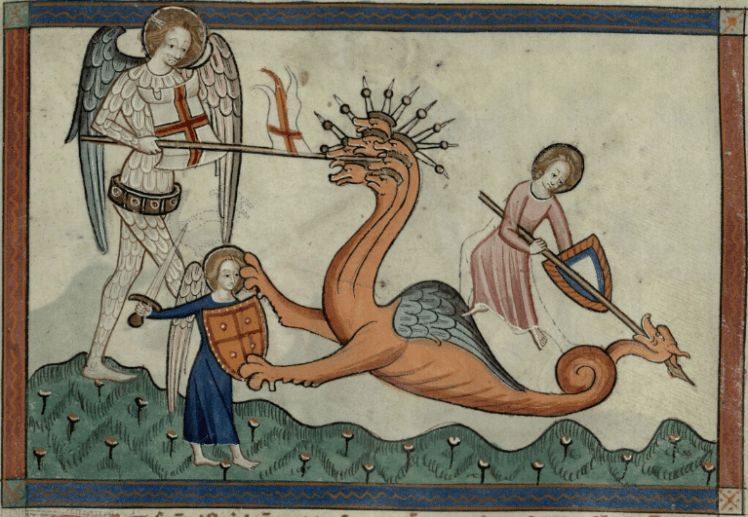
After this vision, this light that comes from heaven upon the Woman and the Dragon, the Apocalypse will give us a deeper understanding of the battle by helping us understand who this Dragon is and by showing us that the first sin is not that of man. The first sin is that of the Dragon; and it is this sin that made him a Dragon; it is sin that created within him this imbalance between his seven heads and his ten horns. Here we go beyond the time of our universe to enter into what was “before”: : “And there was a war in heaven [this is not a subsequent event, but a prior one]: Michael and his angels waged war against the Dragon.” Thus, before the Dragon’s battle against the Woman, there is another heavenly battle—a purely angelic battle, a battle on the level of contemplation and the service that contemplation demands. “And the Dragon waged war, along with his angels, and they did not prevail, and their place was no longer found in heaven. And the Dragon was cast down, the great Dragon, the Serpent, the ancient Serpent, the one called the Devil and Satan, the one who leads the whole world astray; he was cast down to the earth, and his angels were cast down with him.”
Here, we are told very little: a “battle in heaven,” “Michael and his angels.” What is at stake in this battle? There was a battle, and there is no longer any place for them in heaven. This is significant: heaven is the place of contemplation, and angels are naturally contemplative beings. And because of their sin of pride, they have lost their contemplation: there is no longer any place for them in heaven; Michael casts them down to earth.
The Book of Revelation shows us this fall of the devil: his pride causes him to lose his contemplative state, driving him to rush among men like a restless spirit to lead them astray—and not only among men, but even among pigs. This is to help us understand that man’s sin is not the first, and that is why it is forgivable, because there is an older brother who betrayed and led man astray. In a family, it is like this: when we see that the youngest children are influenced by the older ones, what do we do? We punish the older ones, and we are full of mercy for the youngest who let himself be led astray, who let himself be taken in: we shower him with even more tenderness. This is what happens in the great family of spiritual creatures: the devil is our older brother, far more intelligent than we are. From the standpoint of intelligence, he shines in an astonishing way. Our only superiority is that we are capable of love. We have retained this capacity to love, and we have also retained faith, hope, and charity; we are children of God. The devil cannot bear this; we can then understand the enmity that exists between the devil and the Woman, that is, Mary, the Church, and ourselves.
~ AFC, March 17, 1991
 Father Marie Dominique Philippe, O.P.
Leave a comment