Book of Revelation Chapter 12: “Mary clothed with the Sun”
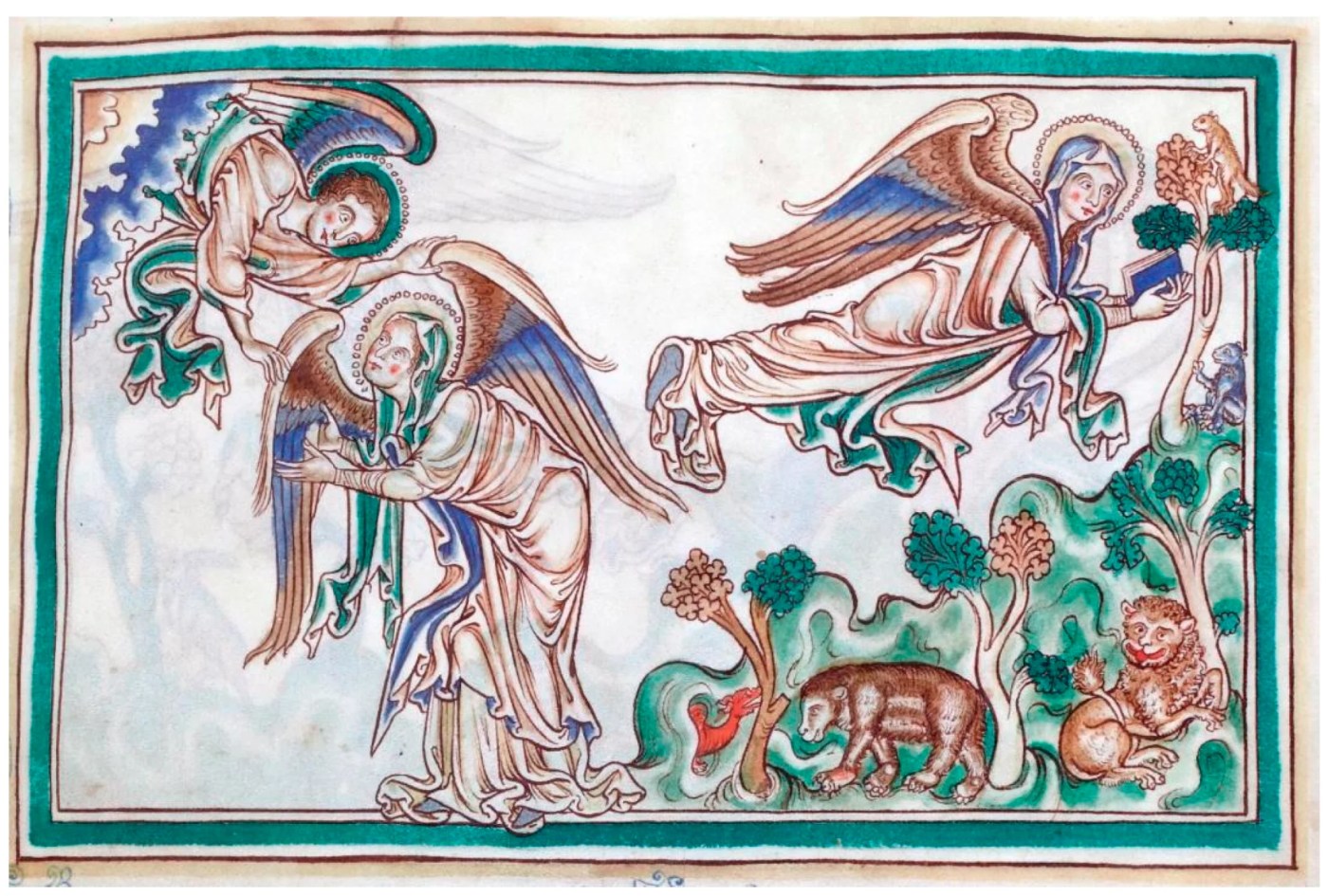
Here Mary appears to us “clothed with the sun.” The sun is Jesus. The fact that she is clothed with it expresses her fullness of grace. “Clothed with the sun” in glory, she is radiant. “The moon under her feet”: this represents the entire corruptible, “sublunar” world, as the ancients used to say. It is our earth. Mary touches this world because she is a little child of humanity, just like us. Mary could have sinned; her body could have experienced corruption, and she did experience the fragility of corruptibility: she suffered in her body and in her sensitivity. “On her head, a crown of twelve stars.” The stars are light; they symbolize doctrine. The stars are always the symbol of doctors, of theologians, of those who seek the truth. Mary possesses this fullness: twelve stars. We can say that these stars represent all the apostles, of whom she is the queen, the mother, and the queen.
If we look closely, we can also see that this symbolism is Trinitarian, expressing the bond with Jesus, the bond with the Holy Spirit, and the bond with the Father. This threefold bond is present in Mary’s glory, and was already present when she was on earth, because the heavenly vision presented to us is eternal, and therefore always present. It is Mary in her earthly journey, and it is Mary in glory.
“She is with child…” This is the great event in the life of the Virgin Mary: her divine motherhood, which gives her her unique nobility. “She is with child”: we think of Mary in Bethlehem, we think of Mary at the Cross; and perhaps this is what exegetes have had such a hard time understanding: that Revelation, being not a historical perspective but an eternal gaze upon time, embraces the succession of time. Mary’s two motherhoods are viewed in a single, unified gaze. One is joyful, the other is sorrowful, and the first is ordered toward the second, since the Incarnation is ordered toward Redemption. If Mary is the mother of God, the mother of Jesus, it is so that at the Cross she might be the mother of John, the mother of the Church, and our mother. The motherhood of Bethlehem happens in poverty yet in joy. The motherhood of the Cross is realized in an even greater poverty, but this time in suffering. “She is with child and cries out in the pains and torments of childbirth.” It is clear that this is not merely physical pain; physical pain is present at the Cross. But it is above all the pain that Jesus experienced in his Agony and that Mary bore in the mystery of the Cross, because she bears with Jesus the iniquity of the world. We see here, then, the great mystery of Mary, and of the Church in Mary, and of each one of us in Mary.
Next comes the antithesis, the Dragon. He appears here in the sky, for the devil can only be perceived through a contemplative gaze of faith. The devil eludes science; he also eludes the philosophers; he eludes our human reason. A contemplative gaze of faith is required to recognize the Dragon’s presence. And in faith, he is always present; here, he reveals himself. “A great Dragon.” It is the power of the Dragon that is manifested here first and foremost, and as we shall see later: the Dragon is both serpent and dragon. Revelation unites the two: the serpent is cunning, and the dragon is powerful. He intimidates the Woman at the very moment she experiences her greatest fragility in her fertility, in the pains of childbirth. All fertility is manifested through great fragility, because it is formed of love, and of the overflow of love. By attacking the Woman at the moment when she is aware of her fragility, he is overly self-confident.
“A great fiery red dragon”: the fiery red color signifies anger. The devil is always angry; from time to time he pretends not to be angry to make us believe we can approach him, but in reality he is always angry. Why? Because he has not accepted the Father’s will for him. Pride very often makes us angry; there are links between anger and pride, as we well know. It is not easy to be truly meek—that is, strong—and to accept certain things we do not understand. Anger erupts when we face an injustice, or at least what appears to us as unjust. We then become angry because we lack strength; if we had more strength, we would control our anger. Here, it is clear: he is angry with the Woman.
“Having seven heads and ten horns”: note the imbalance. The head represents intelligence; the horns represent power. The demon has no authority, but in his pride he claims to be all-powerful—thus the ten horns. He has not lost his intelligence; sin has not taken away his intelligence itself, but the finality of his intelligence. When we are intelligent under God’s guidance, we are intelligent in order to love more. But if one is proud in one’s intelligence, one exalts oneself, and the intelligence, then, is no longer ordered toward love. It is ordered toward power, toward domination; it is desired for its own sake and for one’s own exaltation. We then understand that there are seven heads and ten horns: the ten horns determine the finality of his intelligence. “And on its heads seven diadems”: the horns, the power, are made to acquire these diadems, and these diadems are on its seven heads, that is to say, it is fully aware of them. Seven diadems and ten horns: there is both imbalance and satisfaction. There is the imbalance of power that goes beyond intelligence, and there is self-satisfaction: the devil is perfectly satisfied with himself. There is within him a kind of terrible sincerity: he is certain that he will be victorious and that no one will be able to defeat him; the seven crowns on his heads signify this self-satisfaction.
“And his tail sweeps away a third of the stars in the sky”: this is the devil’s contempt for our universe. If he could destroy it, he would reduce it to dust. He cannot bear the beauty of the universe; he cannot bear that God has created a masterpiece within the physical world. With the pride of a pure intellectual, without any heart, without any love, he utterly despises matter. The devil is an idealist, a supreme idealist, with astonishing grandeur but also supremely contemptuous. “And his tail…”: this is to show his power; he doesn’t even look at this universe—he despises it. “And his tail sweeps away a third of the stars in the sky.” Let us understand the symbolic language clearly: the stars in the sky, the twelve that crown Mary—he cannot make them fall, because they are under Mary’s protection. Yet he would very much like to, for he has a supreme contempt for human intelligence—the stars. He despises them supremely, and that is why he “casts a third of the stars” “down to the earth,” considering all of this to be nothing at all. And he forces them into being relative to the rhythm of the earth, in the most absolute relativity. Intelligence is meant for truth; yet he considers all this to be impossible for man. “He cast them down to the earth”: this is a striking description of the devil’s pride and power. However, his power remains entirely dependent on God, and while God grants him great power, He gives him no authority.
The battle takes place between the Dragon and Mary, between the Dragon and the Church, between the Dragon and each one of us as God’s little creatures, as those loved by God with a unique love. The forces—the Woman in her fragility and the Dragon in his power—seem completely unequal. And it is true; it is a terrible imbalance. Moreover, the Dragon has the cunning to be there at the very moment when the Woman is most aware of her fragility. This is true for the Woman and it is true for man, in the sense that the Dragon cannot stand humanity. If he could destroy all of our humanity, he would destroy it in a single blow. But the demon’s power is limited. Let us recall the Book of Job: God measures the demon’s power, and He grants him no authority over us.
~ AFC, March 17, 1991
 Father Marie Dominique Philippe, O.P.
Leave a comment