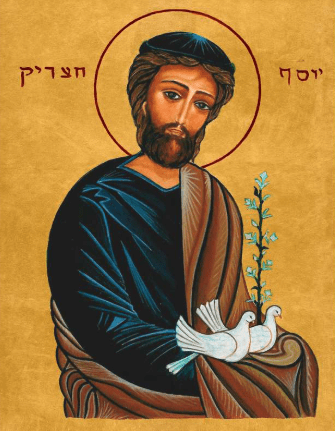
Joseph’s great trial came when God spoke to Mary to ask her consent, [at the Annunciation]. As we have seen, Joseph did not doubt the purity of Mary’s heart: she could not have deceived him – she loved him too much. But she loved God more than she loved Joseph; she loved Joseph in God. Faced with such an unprecedented situation, what should he do? He should perform an act of humility, an act of extraordinary poverty: accept the will of God, the will of the Father, over and above his love for Mary: “She is for God and not for me”. We may think of him saying to Mary, “You are free; act according to God’s gracious will. I was mistaken, but I still love you, and I love you still more because God has chosen you. You are worthy of God; it is to him that you must belong and not to me”. And then the angel comes to Joseph during the night. God rewards him for this heroic act, for this divine prudence: “Take Mary your wife into your home…”. Our prudence requires a holy poverty. We need to understand that our human decisions should always be relative to the Father’s gracious will for us and for those whom we love, and we should consent to this will by stepping aside.
Let us never forget that, as St Thomas Aquinas says, when God allows evil it is always for a greater good. We do not always see it of course, but we do not have to check up on God’s action; we can be certain that in every case it is always for a greater good. Faced with all the evil that is currently going on, that God allows, we must have a sufficiently strong hope to be able to say that if God allows it, it must be for something very great, such as a gift of love that we have never yet known. What is it that discourages us? What is it that makes us despair? It is being faced with an evil to which we see no solution: a dead end… At that moment we must say to ourselves that if God has allowed this evil to happen all around us, has allowed all the sufferings that we may know, it is always for a greater good. For Joseph it was not an evil that he faced, but it was still a very great suffering. God could have forewarned him! But He did not, and this was with a view to a greater good for Joseph: so that he would understand better that Mary was a gift for him from God – an unparalleled, royal gift. We do not see this clearly enough. We do not understand nearly enough that the gift of the Virgin Mary in our lives is an extraordinary gift. To have the same mother as Christ!
To finish with, let us just return to the episode in which Joseph’s prudence is most clearly revealed. If Joseph is for us the model of prudence, of a prudence that is at once human and divine, he is so in the human choice that he made (for there is no choice more human than a husband’s choice of his wife, and Joseph chose Mary without knowing in advance who she was) and also in his fidelity to the Holy Spirit. For it was under the action of the gifts of counsel and of fear of the Lord that he chose Mary and chose her again. The gift of counsel, which puts our intelligence at the service of love, establishes a new order in our activities, an order which is no longer merely that of justice and human prudence, but also that of divine love, of charity. The gift of counsel, assuming prudence without doing away with it, gives us a new lucidity which allows love to be first. The gift of the fear of the Lord (Godly fear), which is at the source of our being poor “in spirit”, allows us to understand that one of the most important aspects of our lives is not to block the action of the Holy Spirit upon us and upon those whom we love – in other words, to have that divine courtesy which consists in always allowing the Holy Spirit to take first place, over us and over all our decisions, and in accepting, consequently, to be sometimes left aside (at least apparently so) – to be “the little ball of God”, like St Thérèse of the Child Jesus.
~ Mystery of Joseph
 Father Marie Dominique Philippe, O.P.
Leave a comment