
Book of Revelation Chapter 12
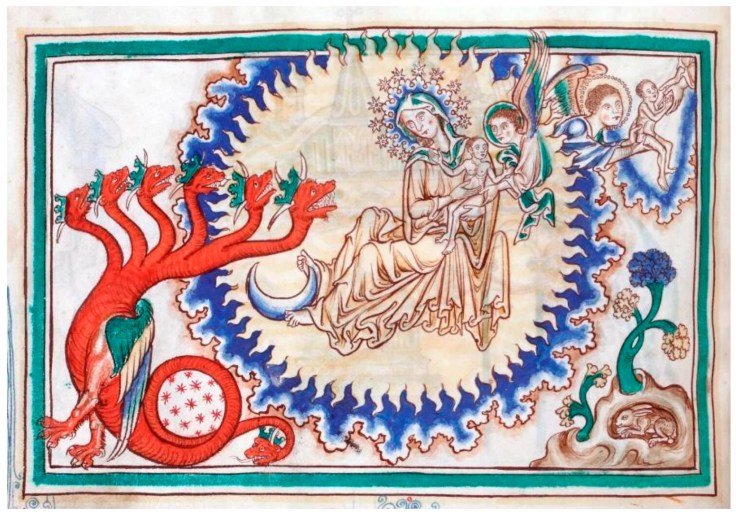
We have thus seen the seven seals, which reveal the mystery of predestination—God’s will for us—and then the trumpets, which is the fulfillment. There is always decision and execution, to bring us into the mystery of God who governs all things. As we have seen, everything is accomplished within a struggle, and chapter 12 serves as a moment of reflectionto give us an understanding of the battle. When we are in the thick of battle (and there is a great battle in which we all currently find ourselves), we do not really know what the purpose of this battle is. And at certain moments, the battle is so intense that we can no longer see anything at all. What, then, is the purpose of this battle? Chapter 12 of Revelation gives us a sign: there is a sign in the sky; God is going to give us a light to help us understand the meaning of the battle.
Let us therefore try to grasp the meaning of this sign, to enter into the mystery and gain an understanding of the great struggle in which we are engaged. “And a great sign appeared in heaven: a woman clothed with the sun, with the moon under her feet, and on her head a crown of twelve stars [this apparition is marvelous and precise]. She is with child, and she cries out in the pains and torments of childbirth. And another sign appeared in the sky [it is extraordinary; the sign is in the sky; the Dragon himself is not in the sky, but the sign is in the sky]; and behold, a great fiery red Dragon, having seven heads and ten horns, and on his heads seven diadems; and his tail swept away a third of the stars of heaven. And he cast them down to the earth. And the Dragon stood before the Woman who was about to give birth, to devour her child as soon as she had given birth to it.” We are immediately given the meaning of this terrible, demonic jealousy of the Dragon toward the Woman. It is jealousy and pride—jealousy is the daughter of pride—that are the source of all struggles, of all tensions, particularly the tensions between brothers and sisters at the time of inheritance. We know this well; it is like this in every family. There are underlying jealousies that resurface at that moment. While the parents are still there, we keep quiet, but once the parents are gone, The democracy bewteen brothers and sisters takes over; and at that moment, jealousy, pride, and strife arise.
Let us try to grasp this symbolism of the Woman and the Dragon. For a long time, exegetes have said that the Woman symbolizes the Church. Recently, the great exegetes of the Apocalypse have not hesitated to say that the Woman is Mary. And it is true: if we look closely, it can only be Mary. We must not oppose these two symbolisms, because the very nature of symbolic language is to be multifaceted, that is, to have multiple meanings. But there is an order to these meanings. It is easy to understand that the primary meaning is the mystery of Mary; the Woman is Mary first and foremost. She is the great sign in the sky, because she is God’s masterpiece. All of creation, in the Creator’s intention is Mary. That is what is extraordinary. As Creator, God wants to bring his masterpiece to fruition, and he has brought his masterpiece to fruition in Mary, in the Woman. It is not Eve; it is Mary. And Mary, in God’s eyes, is not only the masterpiece of creation; she is also the masterpiece of Redemption, in response to the fierce opposition of the Dragon, the devil, against God, in response to the jealousy he harbors toward man. To this jealousy, in fact, God responds by going even further and creating a marvelous masterpiece: Mary, the masterpiece of grace. She is first in the order of grace, she who is already a masterpiece in the natural order: the most refined, loving, and intelligent of all creatures. We will never be disappointed by Mary, and when we see her, we will be amazed: “I thought I understood! ” and we will see that we had understood nothing, that she is even more wonderful than anything that has been said about her. We must not imagine it, but we can be sure that she will be infinitely more wonderful; and the theologians who might have wished to diminish her importance a little will then be forced to beat their breasts, saying: “We did not understand.”
The Woman is Mary and she is the Church, since Mary is the first in the Church and she bears the Church as a mother. And the Woman is also the ultimate and final little creature that we are, the last of all creatures, the most fragile. There are these three symbolisms. That is why, when we are in front of this text, we should offer three successive readings; for there are indeed three successive readings, a threefold perspective that in faith is “one”: Mary, the Church, and the little creature that we are, the most fragile. We are all connected to the Woman: either we are women, or we are connected to the Woman through our mother; we are all connected to the fragility of the youngest, the last, the one whom God created last to express his love more deeply and communicate it more fully. Here we will look first of all at Mary, and that will be enough; we will understand the rest in that light. But let us never forget that in looking at Mary, we look at the Church, and that in looking at Mary, we also look at the little creatures that we are, whom we must always consider in the light of Mary.
 Father Marie Dominique Philippe, O.P.
Leave a comment