
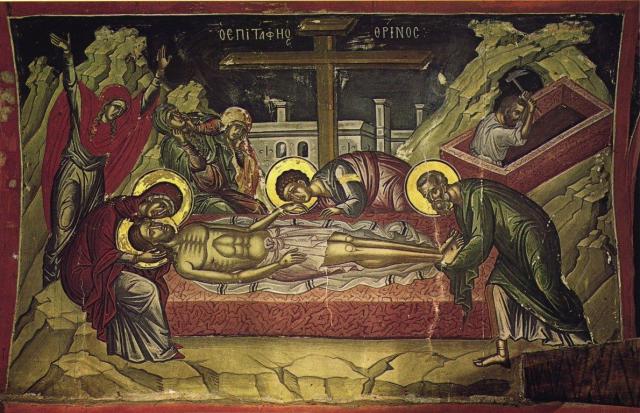
After the mystery of [Christ’s death and ] the wound of the heart is the great mystery of the Sepulcher, the expectation of the Resurrection. Mary lives this mystery of the Sepulcher. According to the Fathers of the Church, Mary alone lives this mystery; it is a mystery reserved to her. It is therefore the descendants of the Woman who must live this mystery, and we can only understand it close to Mary. Mary lives in the most intimate union with the soul of Jesus, the separated soul that descends into hell, and the wounded heart of the Lamb which rests in the Sepulcher. What is lived in the Word is lived in Mary’s heart in a contemplative way, in her faith, hope and love. And Mary lives this separation; she awaits the moment when God the Father will accomplish the Resurrection, the reunification of the separated soul of Jesus with his corpse, a new union that will be brought about in the Resurrection. We must often come close to the Blessed Virgin Mary to enter into this final mystery, this last abasement: Jesus delivered to the bowels of the earth and Mary who lives by this mystery, who lives in order to hasten the hour of the Resurrection. This is the last mystery of Christ’s life on earth and it will be the last mystery of the Church as she awaits the return of Christ. (…)
And he reveals himself as a disciple of Christ at the moment when things are at their worst, when everything is over. That is nobility of heart. When everything is going well, you have many friends. When things are not going as well, you have fewer friends. And when you’re crucified, you have even fewer! This is always the case; it can’t be any other way; it is a very human reaction. Joseph of Arimathea rises at this very moment, at the precise moment when everything seems to be over for Jesus. He has been crucified. The Father did not intervene. For him who rose others from the dead, the Father did not intervene. There was the great silence of the Father, the great silence of Mary, the great silence of the Apostles, the great silence of John and the great silence of all the others. And Joseph of Arimathea is there. He is a pious layman, the great layman consecrated to Jesus, who takes over at the moment when the Apostles, in fact, are absent, except for John. And next to Joseph of Arimathea, who is surely engaged in the political and temporal point of view, there is Nicodemus, the theologian who is part of the Sanhedrin. He, too, had never before openly said that he was a disciple of Jesus. They are the two great witnesses who are there present at the moment when Jesus is totally abandoned. That is why we can say that the mystery of the Sepulcher is the liturgy of the great lay people: Joseph of Arimathea and Nicodemus. (…)
We must pass through the Sepulchre to live the mystery of the Resurrection. This is God’s will so that we may understand that Christ’s death is complete, that we may understand that there was indeed a true death. The Sepulchre is there to attest to the truth of his death. It is there to place in Mary’s heart a true waiting, a divine patience, a thirst for the mystery of the Resurrection.
And the Church must live the mystery of the Sepulcher. She has already lived it, and she will live it in an even deeper way as the return of Jesus approaches, since it is the last step before Jesus’ glorious coming. And this mystery of the Sepulcher can only be lived by Mary and by the descendants of the Woman. I believe that others do not live it; they allow themselves to be distracted, they get agitated, they worry. Mary alone allows us to plunge into this mystery so we won’t waste any time and will wait for the return of Jesus, having only one desire: that the Father’s will be fully accomplished in us and around us.
~ Follow the Lamb
 Father Marie Dominique Philippe, O.P.
Leave a comment