
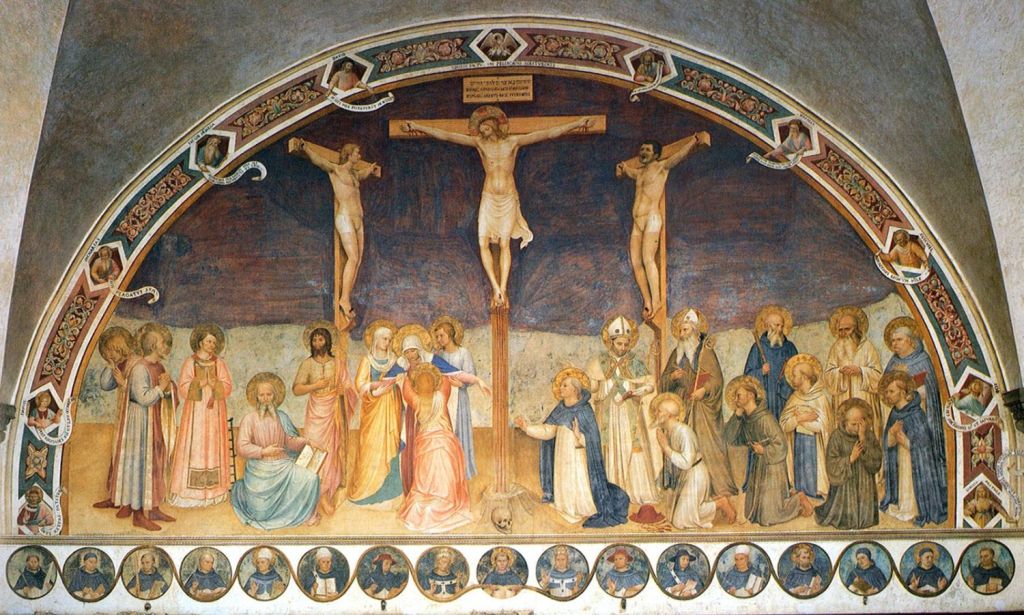
The sacrifice of the Cross completes all the sacrifices of the Old Testament, giving them their finality and containing in a more eminent way all their perfections. This sacrifice is incomparably greater and more profound than those of the Old Testament; it is the supreme sacrifice, because it is that of the Man-God, of the Incarnate Word, who came into this world to accomplish it. Nevertheless, to the Christian the sacrifices of the Old Testament should be ways to approach the sacrifice of Christ, giving us an imperfect yet true and divine outline as it were of this supreme mystery.[1] We should not neglect what God deigned to teach us, in His divine pedagogy, to enable us to understand more fully the mystery of the Cross. Therefore, before considering the mystery in and of itself and its most unique and original qualities, let us consider how each one of these rough approaches tell us one aspect of the mystery.
Like the sacrifice of the seven brothers and of their mother, Christ’s sacrifice, too, is a martyrdom of an only Son and His Mother. Jesus completed His earthly life with the torture and Crucifixion in order to remain faithful to what the will of His Father required of Him. The sacrifice of the Cross, too, is accomplished in an act of obedience. It remains a witness of Christ’s faithful attachment to the will of His Father. The sacrifice of the Cross, too, is an act of adoration that makes amends for the sins of the people of Israel. Jesus offers Himself to the Father as bearing the responsibility for all sinful mankind, answering before the justice of the Father for the iniquity of the world. He is the Lamb of God, who bears the sins of the world. Christ’s sacrifice is a pledge of eternal life. It opens heaven and makes possible our entry into the Kingdom of God. It is inseparable from the mystery of the resurrection, of glory. Hence it is that to St. John the mystery of the Cross is the glorification of the Father. Mary is silently present. She is given to the youngest of the apostles to help him remain faithful to the end.
Like the sacrifice of Elijah, the sacrifice of the Cross, joined to the mystery of the resurrection, is the supreme sign of Christ’s divinity, of the true divinity of Him who sent Him. It is the only sign Christ gave, a sign symbolized in the Old Testament by the prophet Jonah, who remained for three days in the belly of the whale. The sacrifice of the Cross is a sacrifice that is carried out by the breath of love, the fire from heaven that comes down and consumes the whole victim. Jesus Himself gave up His soul at the moment willed by the Father, when the Father (in His soul) took Him to Himself. When men nailed Christ to the wood of the Cross, He showed by His sacrifice and resurrection that He had indeed been sent by the one God. The sacrifice of Christ on the hill of Calvary was accomplished after a contest in which Jesus overcame Lucifer. He unmasked the kingdom of the Prince of this world.
Christ crucified is our Passover, the true Passover, the “passing by” of God who delivers us from the yoke of slavery to sin and who leads us through the “desert” to the “promised land,” to the land of life, our heavenly home, to glory.
Before the Cross came the Last Supper, and this continues for us in the mystery of the Eucharist, that divine, family meal, by which we are fed on the flesh of the Lamb who has been sacrificed.
The sacrifice of the Cross is the offering of the true Isaac, the “child of promise,” immolated as the son of promise and as the “scapegoat” taken from the thicket. This theological sacrifice, carried out wholly in obedience to the will of the Father, expresses the loving choice of Jesus for His Father. Jesus knew that He was crucifying the heart of His Mother when He accepted the mysterious will of His Father. He knew that He was crucifying His beloved disciples and He drawing them to Himself, the Crucified One, to allow them to be with Him, and in Him to be crucified. He was prepared to drink the chalice which His Father willed Him to drink—“not my will, but thine, be done,” He said in His prayer to the Father in the Agony of the Garden.
The sacrifice of the Cross is the simplest and most perfect of the acts of sacrifice, or of offering, or of thanksgiving, purer than that of Abel, more perfect than the thanksgiving of Noah. By offering His body as a victim of love and worship, He offered to the Father the first-fruits of all humanity, the most excellent and wonderful thing produced by the world. He offered to the Father an utterly pure victim.
The chief priests and Pharisees decided on His death out of fraternal and religious jealousy. Did He not blasphemously claim to be the son of God? Had He not violated the law of the Sabbath?
While the sacrifice of the Cross gathered together in itself all the perfections of the sacrifices of the Old Testament that prefigured it, it was also carried out in a more eminent way. What the types could not express (because they were only types and, as such, could not proclaim what types cannot give), the mystery of Christ crucified carried out and gave us: the sacrifice of the well-beloved Son of the Father, giving Himself to us as our Savior.
None of the perfections discovered and acknowledged in the types disappeared, but all were changed in this final consummation, the masterpiece of God’s wisdom. The sacrifice of the Cross is above all the sacrifice of love, the love of the Son for the Father, and of the Father for the Son, the love of the Father for us and of the Son for us, a love which is revealed to us and granted to us. It is the gift of the well-beloved Son that is made to us on the Cross. The mystery of the Eucharist bears witness to it and communicates it to us, indeed to every man who is redeemed by the blood of Christ. The Cross is the great revelation of love for us, in that new worship “in spirit and truth,” accomplished by the Son. Or, if one prefers, it is a loving worship which wholly takes possession of Christ and reveals to us His love for the Father and for us, and the love of the Father for Him and for us.
[1] Cf. 1 Cor. 10:11: “When all this happened to them, it was a symbol.”
~ Excerpt from You Shall Worship One God
 Father Marie Dominique Philippe, O.P.
Leave a comment