
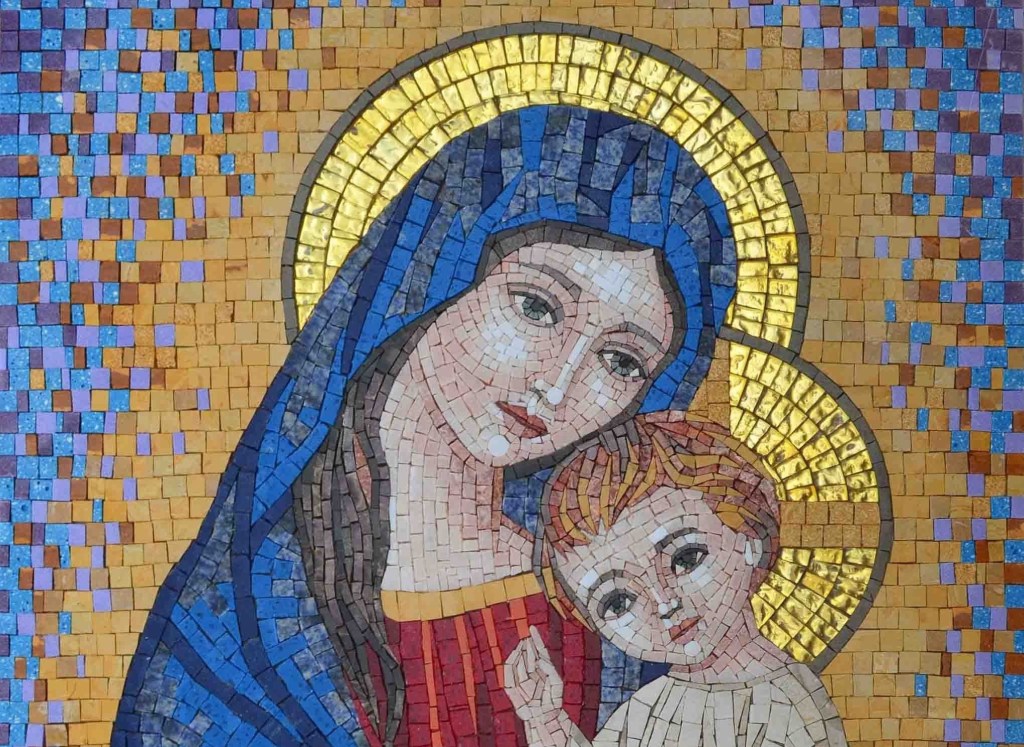
Model of the Growth of our Christian Life
The pure creature who lived most by Christian grace, who exploited all its riches while still being immersed in the realm of faith and hope here on earth, is the Most Holy Virgin. Through Gabriel’s salutation and the fiat, Scripture testifies to the exceptional fullness of grace and charity which the Holy Virgin possessed at the Annunciation in her state as a believer. Tradition presents her to us as the creature who experienced the closest intimacy with God and Christ, the one who received the greatest love from the Father and Christ. The dogmas of the Immaculate Conception, of the divine Motherhood and of the Assumption present her to us as being looked upon by God and Christ in a unique manner, as having received from Them the greatest graces and mercies that a pure creature can receive. Some theologians further specify that the fullness of her initial grace is more perfect than the grace present at the end of the earthly live of the greatest saints. The fullness of her grace in the final act of her earthly life is of course incomparably more perfect still. And since she never committed any sin or refused the divine will anything, we can then conclude that she is indeed first in the order of the growth of charity; she is the one who took advantage of her time of trial in the most perfect and divine manner. If she is first among those who are to grow in the order of divine life, she is therefore the model of the growth of our Christian charity, since the first in a given genus is the model and exemplary cause of all those who are in that genus.[1] Speaking of true devotion to Mary, St. Pius X notes that perfect devotion to Mary must imitate her example: “It is a divine law that those only attain everlasting happiness who have by such faithful following reproduced in themselves the form of the patience and sanctity of Jesus Christ: ‘for whom He foreknew, He also predestined to be made conformable to the image of His Son; that He might be the first-born amongst many brethren’ (Romans viii., 29). But such generally is our infirmity that we are easily discouraged by the greatness of such an example: by the providence of God, however, another example is proposed to us, which is both as near to Christ as human nature allows, and more nearly accords with the weakness of our nature. And this is no other than the Mother of God. ‘Such was Mary,’ very pertinently points out St. Ambrose, ‘that her life is an example for all.’ And, therefore, he rightly concludes: ‘Have then before your eyes, as an image, the virginity and life of Mary from whom as from a mirror shines forth the brightness of chastity and the form of virtue’ (De Virginib. L. ii., c. ii.).”[2]
Should we not say, as some people do, that she is too perfect to be our model? Such an objection shows a misunderstanding of the proper nature of a model. The more perfect, ideal and pure the latter, the more it can play its role as model by fully exerting its attraction as exemplary cause. The model is, by nature, an ideal but a concrete ideal, already realized in a more perfect being which goes before us. Because a model is an “ideal”, it can attract and fascinate us. The more perfect the model, and in a certain way the more transcendent, the more immanent and intimate it can be.
The growth of charity in Mary is truly for us a
pure, incomparably beautiful ideal. But this ideal of growth is at the same
time as close to us as it is possible to be. Is it not the growth of our divine
Mother’s heart? The growth of a virginal and immaculate heart is that of a
maternal, merciful and welcoming heart.
[1] St. Ambrose, De Virginibus in Nicene and Post-Nicene Fathers, First Series, Vol. 10 (Peabody, Massachusetts: Hendrickson Publishers, 1995), Bk. II, Ch. II, §6, p. 374. Cf. Les plus beaux texts sur la Vierge Marie, presented by P.R. Regamey, La Colombe, Paris 1946, p. 56.
[2] Cf. Encyclical Ad diem illum, §20, February 2, 1904. Acts of Pius X.
— The Mysteries of Mary
Subscribe below to get notified when there are new updates
 Father Marie Dominique Philippe, O.P.
Leave a comment